
Introduction
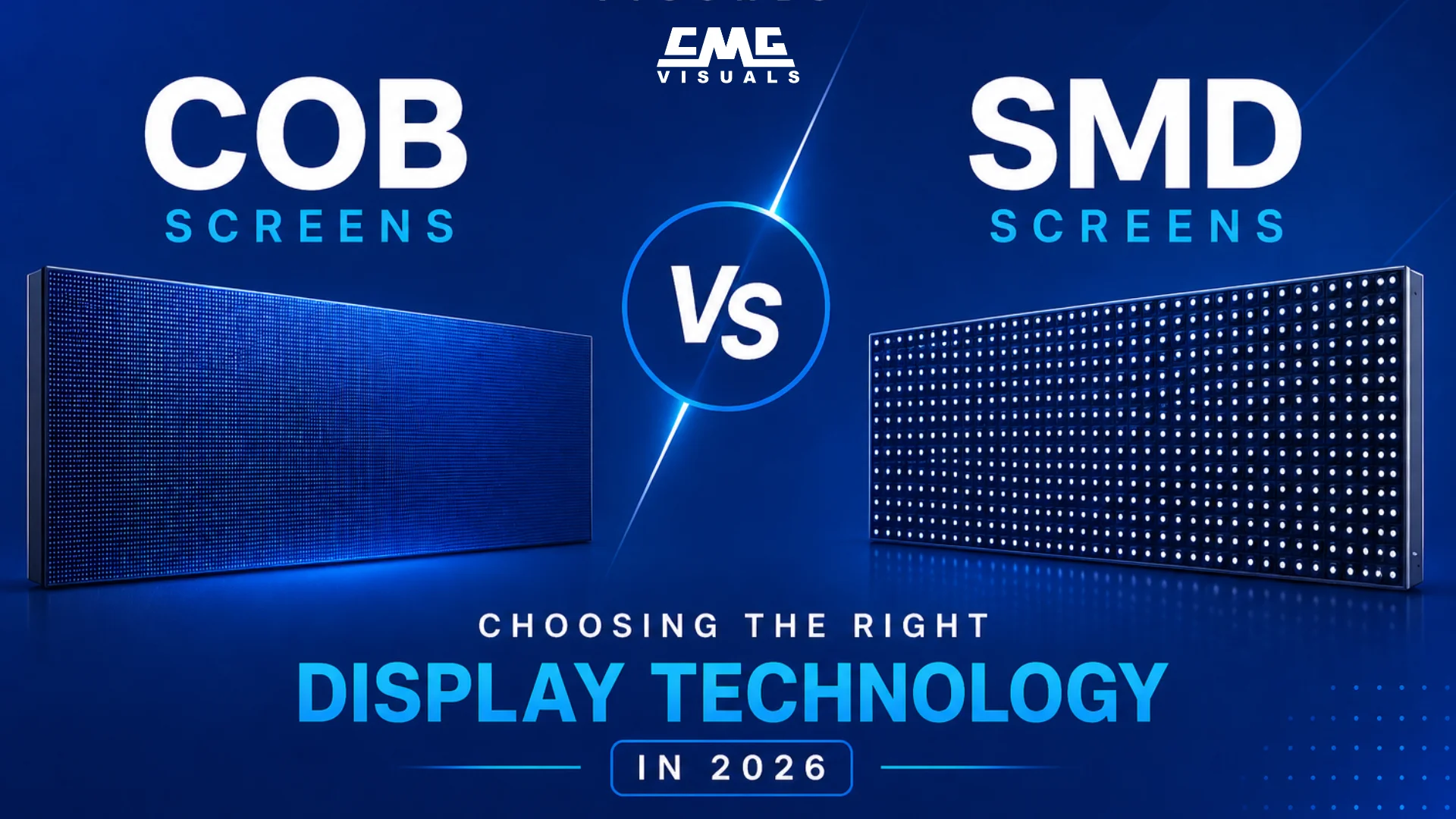
As LED display technology continues to advance, choosing between an SMD (Surface-Mounted Device) or COB (Chip-on-Board) screen for your project is more important than ever. Both types have their advantages and disadvantages, and choosing the right one for your project greatly depends on the requirements and use cases.
As we welcome 2026 with advancements in brightness, resolution, and energy efficiency, businesses, marketers, and designers need to know the differences between these two technologies. In short, SMD is great for high brightness and color uniformity, and COB is perfect for fine-pitch displays in high-traffic environments.
| What Are SMD Screens?
SMD screens, also known as Surface-Mounted Device screens, are made up of millions of tiny individual LEDs, each of which contains red, green, and blue diodes. They are attached to a circuit board directly to create a dense array of lights. This arrangement enables SMD screens to produce images, video, and text.
Advantages of SMD Screens
Crisp Images: SMD screens deliver high-quality images. They are ideal for medium to far viewing distances, such as outdoor advertising, retail displays, or indoor digital signage.
High brightness: SMD LEDs' design allows them to maintain a high brightness and color uniformity. The display performance of SMD is perfect for scenarios where light intensity matters most.
Accurate Colors: Each SMD package can stay calibrated for many years of operation without needing adjustment. SMD displays can be run at up to 16-bit color depth.
Challenges with SMD Screens
Although SMD screens are great for medium to far viewing distances, they become cost-prohibitive when used for fine pixel pitch. In short, with the lower cost of COB, SMD for any pixel pitch below 1.9 does not offer a great value. Lastly, SMD screens also generate more heat and consume more power, meaning they need to be well-ventilated or cooled to ensure longevity and efficiency.
| Introduction to COB Screens: Waterproof and Smooth
Chip-on-Board (COB) screens, as the name implies, are where the LED chip is directly mounted to the PCB board. There is no solder joint, meaning the display can experience lower energy consumption and heat dissipation. COB displays also have a smooth surface that is IP65 rated, meaning they are more durable for high-traffic environments.
Advantages of COB Screens
High Resolution: COB displays are ideal for fine-pixel pitch and high-resolution screens. The smallest stable pitch is around 0.4mm. The most common pixel pitches for COB displays in 2026 are P0.9 and P1.25. Chip-on-board displays are great for environments such as boardrooms, hallway message boards, digital signage kiosks, and home theaters.
Wide Viewing Angle: Because COB pixels are directly mounted on the PCB, they can achieve a 180-degree viewing angle. Additionally, the lack of a mask for the pixels means that the viewing distance is further increased.
Lower Power Consumption: COB screens have lower power consumption because they are directly attached to the PCB. Since there are no solder points in between the pixel and the PCB, there is no inefficiency in creating heat dissipation. This reduction in heat can allow for a 40% reduction in power consumption while achieving 1k nit brightness.
Durability: COB screens are durable. The front face of a COB LED screen is IP65 rated and has a hard material finish, where impact does not damage the pixels. Using COB in high-traffic areas ensures that no damage to the display can be done.
Limitations of COB Screens
COB screens can struggle with color uniformity, shifting colors after installation, and are difficult to repair. With these three factors in factors in mind, it's important to balance where the screen is going and what parts matter most.
| COB vs SMD screens: the differences
When selecting a screen, it's essential to consider the differences:
- Detail and Resolution: COB screens have higher resolution, while SMD screens are better suited for high-brightness environments and where color uniformity matters most.
- Viewing Range: COB offers short viewing distances (1-10 meters), SMD is for long viewing distances (10+ meters).
- Durability: COB screens are superior in indoor high-traffic conditions due to their sealed front design. SMD screens are generally better for indoor/outdoor and high-brightness environments.
- Installation and Maintenance: COB screens and SMD screens generally have the same process for installation. COB when left on for extended periods of time might need color calibration sooner than SMD. As far as repair goes, SMD is much simpler to repair and can be done locally.
| Which Screen Technology is Best in 2026?
In 2026, improvements were made to both SMD and COB screens. COB pitches have gotten finer while SMD has gotten brighter. Depending on the project at hand, your requirements will determine what is best.
COB Screens in 2026: Sharp and Accurate
COB screens are the latest trend for new projects. For fine pixel pitch, they are the go-to choice for integrators when it comes to indoor display technology. COB screens offer high resolution and fine pixel pitch options. This means that boardrooms and environments where TVs and projectors once stood are being slowly replaced.
- Indoor video walls and control rooms
- Retail and hospitality displays
- Interactive displays in museums or art galleries
- If viewers will be up close to the screen, COB is still your best bet in 2026.
SMD Screens in 2026: Seamless, Bright, and Durable
- SMD has come a long way in recent years. Today's SMD screens are:
- Consistent light and color over large areas
- Enhanced visibility outdoors
- Improved resistance to outdoor elements
They are ideal for outdoor applications like stadium displays, transportation centers, and advertising banners. SMD is becoming the standard for projects that require long-term reliability and clear images from a distance.
When to Use SMD and COB Screens
- Signage for retail environments
- Large display video walls
- Museums, airports, and exhibits
- Outdoor screens and billboards
SMDs benefit is that it provides bright and uniform images.
| Conclusion
SMD and COB screens are still both more relevant than ever before. Choosing what technology to go with heavily depends on your project needs, viewing distance, environment, and design. COB is ideal for high-resolution applications at close viewing distances in indoor settings, offering rich colors and fine details. SMD is best for large, long-range, and outdoor screens, providing seamless images, easy maintenance, and robust construction.
By selecting the right display technology, not only will your content shine, but you will ensure your display is future-proof. Whether you opt for COB’s sharp detail or SMDs’ high-octane seamlessness, your decision will deliver remarkable viewing experiences.
| FAQs
1. What's the difference between COB and SMD displays?
The way COB and SMD displays differ is how they are attached to the PCB board on the LED module. COB screens have individual LED packages mounted onto the PCB, whereas SMD screens have multiple LED chips mounted on a substrate. COB is optimal for clarity and detail, while SMD is better for large, seamless, high-brightness displays.
2. Which is the better option for indoor displays: COB or SMD?
COB displays are generally better for indoor use due to their higher image quality, pixel density, color accuracy, and detail at close viewing angles. SMD can also be used when going above P1.9 pixel pitch.
3. Is COB suitable for outdoor use?
Yes, COB screens can be used for outdoor, however, SMD is best. SMD displays are brighter, weather-resistant, and have better color uniformity over a longer period of time. SMD is gradually replacing DIP displays worldwide.
4. Which screen is more rugged?
When it comes to indoor fine pixel pitch, COB screens are more durable because the COB modules have a hard protective layer that covers the LED chips. This makes them suitable for long-term use in high-traffic environments.
5. Which screen is better - COB or SMD - in 2026?
Use COB for high resolution, clear text, and up-close viewing indoors. Choose SMD if you need an easy-to-maintain display for large-scale outdoor or distant viewing applications.